Why USDT has several networks and how to pick the right one
What TRC-20, ERC-20 and BEP-20 mean, where they came from and why the network you choose decides whether a transfer arrives.
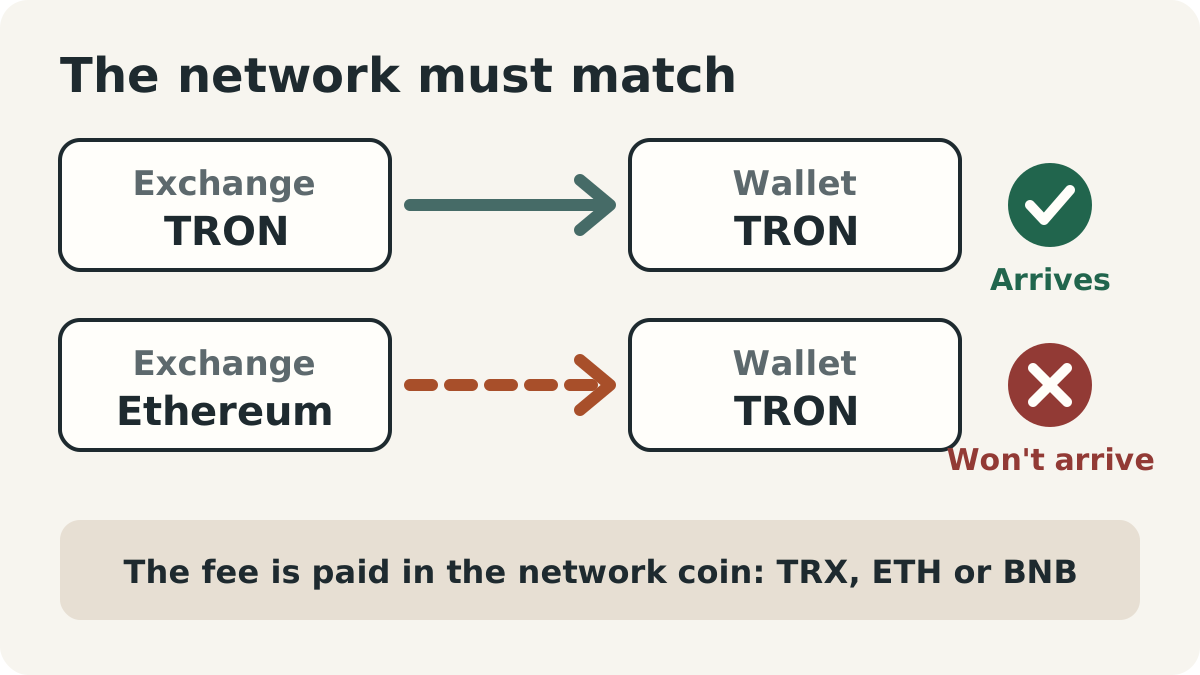
USDT exists on several blockchains at once. The token has the same name everywhere, but each network keeps its own history of transfers and knows nothing about the others. So the sender's and the receiver's network must match. The transfer fee is taken by the network, and you pay it in that network's own coin.
Say you bought 100 USDT on an exchange and want to move them to your own wallet. You press “Withdraw”, paste the address, and the exchange asks an unexpected question: which network should it use?
The list shows TRON, Ethereum, BNB Smart Chain, TON. Each has its own fee.
Which one do you choose? And does it even matter?
It does, and whether the money arrives depends on it. To see where the difference comes from, let's go back ten years.
How USDT ended up on several networks
USDT appeared in 2014, and at first it lived on the Bitcoin network. Tether had no blockchain of its own, so the token was issued on top of Bitcoin using a technology called Omni.
Then Ethereum arrived, and issuing tokens became much easier there. We covered this in the article on how cryptocurrency began. Tether started issuing USDT on Ethereum too.
Next came TRON, Solana, TON and other networks. Exchanges and users wanted to send USDT faster and cheaper, and each new network offered its own terms. Tether went where the demand was.
Meanwhile the old networks emptied out. In 2023, Tether stopped issuing USDT on Omni because almost nobody used it. In 2025, the company shut down USDT on five legacy networks. Since 1 September 2025, tokens left there can no longer be redeemed for dollars.
Today most USDT lives on two networks. In summer 2025, about 81 billion dollars' worth of USDT had been issued on TRON and about 74 billion on Ethereum.
One token, different roads
Here is the key thing to understand. USDT on TRON and USDT on Ethereum are not one token in two places. They are two separate tokens, each on its own network. Tether makes sure both are worth about a dollar, but the blockchains know nothing about each other.
Picture two railways with different track widths. The cars carry the same cargo, but a train on one line cannot roll onto the other.
Transfers work the same way. If the exchange sends USDT over TRON, it arrives only at an address on TRON. A wallet waiting for USDT on Ethereum will not see it.
Hence the main rule: the sender's and the receiver's network must match.
What TRC-20, ERC-20 and BEP-20 mean
These letters on the withdrawal screen scare beginners, but the meaning is simple. They are the names of the standards tokens follow on a specific network. ERC-20 belongs to Ethereum, TRC-20 to TRON and BEP-20 to BNB Smart Chain.
So “USDT TRC-20” simply means “USDT on TRON”, and “USDT ERC-20” means “USDT on Ethereum”.
BNB Smart Chain has a catch. It is not on Tether's official list of networks: Tether does not issue USDT there directly. But the transfer rule is the same, the network must match.
Many people know USDT on TON from the wallet in Telegram. When you deposit to an exchange on this network, you sometimes also need a transfer comment (memo). Binance, for example, requires one for TON.
Where the trap hides
Most often you can spot a mistake by the address. On TRON an address starts with the letter T, and on Ethereum with 0x.
But Ethereum and BNB Smart Chain addresses look exactly alike. The same 0x… address exists on both networks. An exchange will accept it with either one selected and will not warn you.
So check the network on its own, instead of hoping the withdrawal form will stop a wrong transfer.
Who takes the fee and why you need a second coin
The transfer fee goes not to Tether but to the network that records the operation. And you pay it in the network's own coin: ETH on Ethereum, TRX on TRON, BNB on BNB Smart Chain.
That leads to a common situation. Someone withdraws USDT from an exchange to their own wallet on TRON, and a month later wants to send it on. The wallet says: insufficient funds.
The USDT is there. But there is no TRX in the wallet to pay the network.
Some wallets can take the fee in USDT itself. Trust Wallet, for example, rents TRON network resources in that case and shows the final price before you confirm. If your wallet cannot do that, keep a little of the network's coin in it.
Withdrawing from an exchange is simpler. The exchange pays the network itself and charges you a withdrawal fee. It is shown on the screen for each network, and that is the amount to compare.
What happens if you pick the wrong network
It all depends on who controls the receiving address.
Say you sent USDT to your own 0x… address on BNB Smart Chain instead of Ethereum. The money is not lost. It sits at the same address, just on another network. Switch the network in your wallet and the USDT will show up. To send it on, you will need a little BNB. This works if you have your wallet's recovery phrase.
If the address belongs to an exchange or another person, only the owner of the address can return the money. An exchange does not have to do it. Binance, for example, has a paid recovery: under its rules as of 29 May 2026 it costs 20 USDT, takes up to 30 business days and does not guarantee a result.
If you made a mistake, contact only the official support inside the app. Search results are full of “crypto recovery services” with phone numbers. Do not pay them and do not share your recovery phrase: real support never asks for it.
How not to get it wrong: a one-minute check
- Find out which network the receiver expects. If you are sending to yourself, open “Receive” in your wallet and look at the network.
- Choose the same network on the exchange. If it is not on the list, do not send.
- Check how the address starts: T… for TRON, 0x… for Ethereum and BNB Smart Chain.
- Check whether a transfer comment (memo) is needed. The exchange says so on the deposit screen.
- The first time, send a small test amount. It costs an extra fee, but a mistake would cost more.
The country guides in the English section show which networks each service supports.
Takeaway
USDT started on one network and today lives on about ten. Each new network made transfers faster or cheaper, but more choice also brought more room for mistakes.
The token's name tells you what you are sending. The network tells you which road the transfer will take. If the sender and the receiver chose different roads, the money will not meet.
So before every transfer, three checks are enough: the same network on both sides, the right start of the address and some of the network's coin for the fee. It takes less than a minute and saves you from one of the most unpleasant beginner mistakes.