Can Tether freeze your USDT
Why USDT has an emergency brake, when Tether blocks addresses and how someone else's transfer history can become your problem.
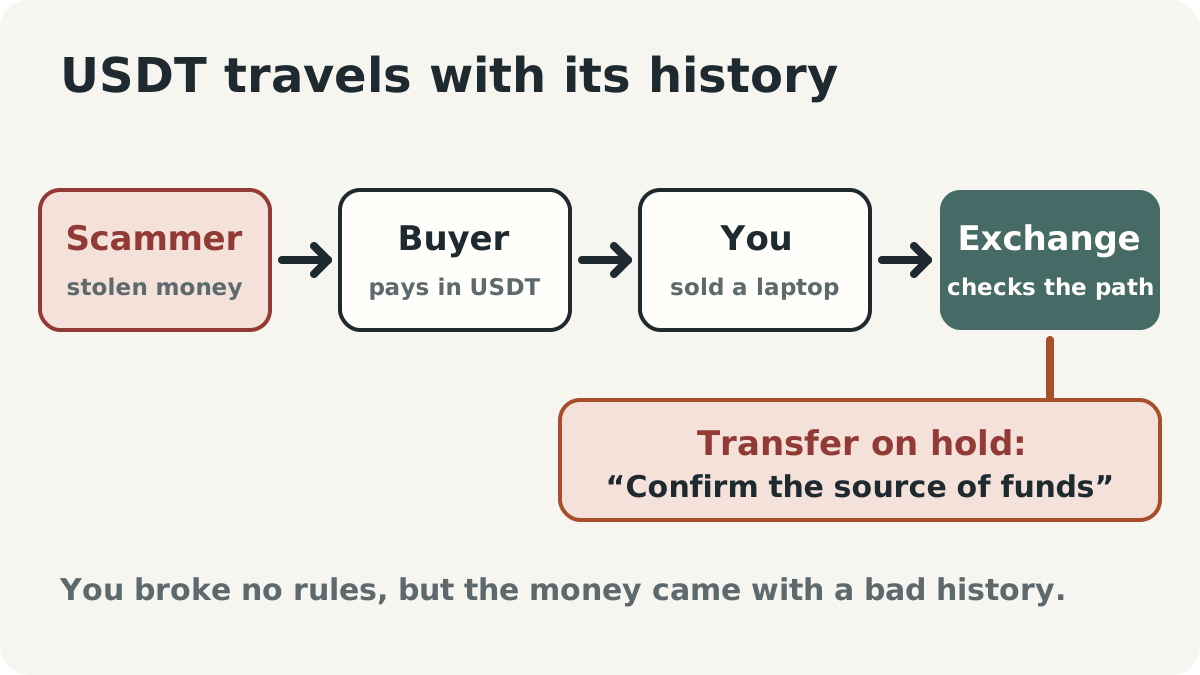
Yes, it can. USDT is issued by the company Tether, and the token's rules include a function that blocks an address. Tether uses it at the request of police and for addresses on sanctions lists. For an ordinary person, a different risk is more likely: an exchange holds a transfer because the USDT came from a doubtful source.
Say you are selling a laptop. The buyer offers to pay in USDT: 500 USDT to your wallet, fast and without a bank. You agree, the money arrives and the laptop leaves.
A month later you decide to sell those USDT and send them to an exchange. But instead of a credit, you get an email: “Confirm the source of funds”. The money does not appear on your balance.
You broke no rules. But shortly before the deal, the buyer received those USDT from an address linked to fraud. The exchange's screening system noticed.
How is that even possible? The answer lies in how USDT differs from Bitcoin.
Bitcoin has no owner, USDT does
Bitcoin belongs to no one. The network's rules are the same for everyone, and nobody can block someone else's address on the Bitcoin network: not the developers, not a government.
USDT is different. It is a token issued by a specific company, Tether. The token's rules are written in a program on the blockchain, a smart contract. And some of the buttons in that program are available only to Tether.
One of those buttons puts an address on a blacklist. After that, the USDT at the address is still visible, but it cannot be sent. The address cannot receive new USDT either. Another button lifts the block, and a third destroys the USDT at a blocked address.
It is like a store gift card. As long as all is well, you can pay with it, give it away or pass it on. But the store has the right to block a specific card if it learns the card was bought with stolen money.
Tether has written this right directly into its terms of service.
Why addresses get blocked
The first reason is requests from law enforcement. Police investigating a fraud or theft find the addresses where the money went and contact Tether.
The second reason is sanctions. Since December 2023, Tether itself blocks addresses of people and companies on the US Treasury sanctions list. And not only its own customers, but any owners of such addresses.
This is not rare. According to Tether, by April 2026 the company had frozen more than 4.4 billion dollars in USDT. In 2025 alone, more than 4 thousand addresses on Ethereum and TRON were blacklisted.
What this means for an ordinary person
Back to the laptop. If Tether blocks the scammer's address, it hits the scammer, not you. A block applies to a specific address. USDT that left it earlier is not affected.
Your 500 USDT stay in your wallet, and you can send them.
The trouble starts at the next step, when the USDT reaches an exchange. Exchanges screen incoming transfers: they look not only at your address but at the path the money took. This screening is called AML, short for anti-money laundering.
If the transfer history passes near addresses of scammers, sanctioned companies or stolen funds, such USDT is called “dirty”. There is no official term, but the meaning is clear: money with a bad history.
What does a service do when it sees such a transfer? Here is how Crypto Bot in Telegram, for example, describes it. The deposit is held while the review runs. The user is asked to pass verification and show where the money came from: a statement, a contract or a receipt. If the transfer is still judged too risky, it is not credited, and the funds may be withdrawn to an outside wallet.
Exchanges have similar rules. Bybit, for example, limits withdrawals for a day after deals its system considers risky.
How not to end up like the laptop seller
- Buy and sell USDT through licensed exchanges and exchangers, not from random people. The country guides in the English section list services and how to check their status.
- If you take USDT as payment from a stranger, remember: along with the money you get its history.
- On P2P, accept money only from the person named in the deal. A payment from a third party often means you are being sent stolen money.
- Do not forward other people's USDT at the request of friends or strangers, and do not accept USDT “for a small favor”.
- Keep records: where and when you bought the USDT, your messages, your trade history. If an exchange asks about the source of the money, they will help.
The internet is full of services that check whether a wallet is “clean”. They show a rating from a private company, not a decision by Tether or your exchange. It is a hint, not a guarantee.
If a transfer has been held
Reply only through the service's official support, in the app or on its site. Attach the documents they ask for and wait for the decision. Nobody outside can speed up the review.
If Tether itself blocked the address, only Tether can lift the block. It does happen: in 2025 blocks were lifted from several hundred addresses.
Be careful with “unfreezing specialists” who find victims on social media. Do not pay them and do not share your wallet's recovery phrase. Real support never asks for it.
Takeaway
USDT is convenient because it is worth about a dollar and moves fast. But that convenience has a flip side: the token has an owner, and the owner can stop the money at a specific address.
Tether does this at police request and for sanctioned addresses. An ordinary person more often meets something else: an exchange notices that the USDT came from a doubtful source and holds the transfer.
So here is a simple rule. The fewer random people and opaque deals in the history of your USDT, the lower the chance that someone else's problems become yours. Buy and sell through checked services, accept money only from the other party of the deal and keep your records.