How cryptocurrency began and why Bitcoin was only the start
Why digital money needed a blockchain, where exchanges, tokens and stablecoins came from, and why even a simple USDT purchase takes several steps.
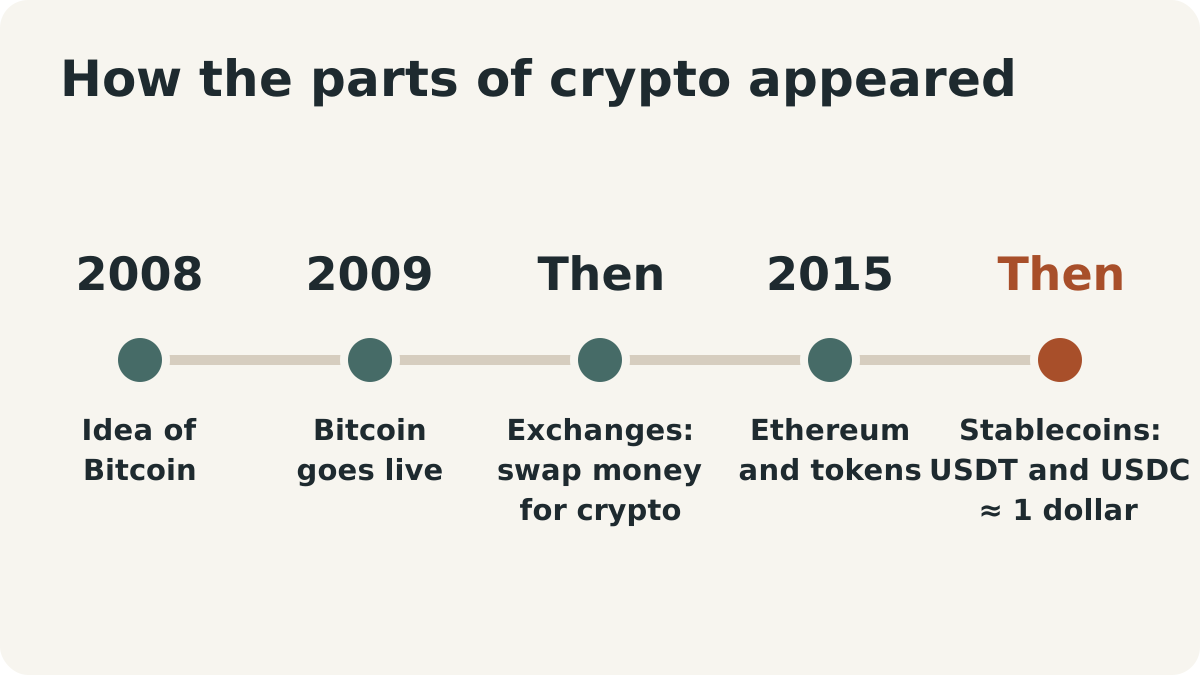
Cryptocurrency appeared as a way to pass digital value along without a bank that keeps the only record of operations. Bitcoin solved the problem of spending the same digital money twice with a shared history of transfers that a network of participants checks. Later came other blockchains, smart contracts, tokens and stablecoins.
Say you have 100 dollars in your account. You send them to someone, and the bank takes that amount off your balance. You cannot send the same 100 dollars a second time.
Now take the bank away.
If money exists only in digital form and nobody keeps a shared account, you need some other system to remember: these 100 have already been sent and now belong to someone else.
People experimented with digital money without a single center long before Bitcoin. In 2008, a person or group using the name Satoshi Nakamoto published a description of a system where the history of transfers is kept and checked not by one bank but by a network of participants.
In January 2009, the Bitcoin network started working.
Information about operations is gathered into blocks, and each new block is linked to the one before it. The result is a shared, ordered history of transfers: the blockchain. The network checks that the sender has the right to spend the funds and that they were not spent before.
That is how digital money can be sent to another person without a bank to carry out the operation.
But first you need to get Bitcoin somewhere
If someone has already paid you in Bitcoin, you reach those funds through a crypto wallet. With it you can check your balance and prepare a transfer to another address.
But most people start out with dollars, euros, rupees or another regular currency, not Bitcoin. So they need an exchange.
At first, people bought Bitcoin directly from each other. As interest grew, platforms appeared that brought buyers and sellers together. Such a platform is called a crypto exchange.
For example, a person deposits 100 dollars, buys Bitcoin with it and can then move the coins to their own wallet.
The exchange and the blockchain do different jobs. The exchange helps you buy or sell crypto. The blockchain keeps the history of ownership and transfers under the network's rules.
Why it did not stop at Bitcoin
Other cryptocurrencies began to appear because developers wanted to change how fast operations go through, what they cost, what the network can do and how participants work together.
Bitcoin was not a closed system owned by one company. Its design and code were open to developers, so the experiments could go on.
Could you build a different network? Confirm operations faster? Change the fees? Organize the participants another way?
That is how other blockchains with their own coins began to appear.
Then the idea went beyond sending money. The Ethereum network, launched in 2015, made it possible to put programs on the blockchain that run by rules set in advance. These programs are called smart contracts. How they work is explained in the Ethereum documentation.
Now it was possible to create new digital assets without building a separate blockchain for each one.
This is where the difference between a coin and a token comes from.
Bitcoin has its own network and its own coin, BTC. Ethereum has its own network and the coin ETH.
A token is created on a network that already exists. A project does not have to build its own blockchain: it can use Ethereum, for example, and issue its own token there.
Shared rules for such tokens appeared. One of the best known standards, ERC-20, lets wallets and other apps handle many different tokens on Ethereum in the same way.
Creating new crypto assets became easier, and their number started to grow fast.
Why USDT and other stablecoins were needed
Stablecoins were needed for cases where you want to pass on a set amount and not depend on swings in the price of Bitcoin.
Say you need to send someone 100 dollars. You buy Bitcoin for that amount, but its price moves. By the time it arrives, or by the next transfer, the coins may be worth something else.
For an investor, a price change can be the reason to buy Bitcoin. For someone who just needs to send about 100 dollars, it gets in the way.
That is how stablecoins appeared. Their value is kept close to a chosen regular currency, most often the dollar.
USDT and USDC are stablecoins. Their issuers aim for one token to be worth about one dollar and state reserves to support that value. Tether and Circle publish details of their reserves on their sites. Still, the market price can drift, and the terms for issuing and redeeming USDT and USDC are different.
USDT is a token and is issued on several networks. So when you send it, you need to pay attention not only to the token's name but also to the network. You will find USDT on Ethereum or TRON, for example.
Why a simple purchase takes several steps
Over time, the original idea of digital money gained new layers.
There are different coins and tokens, blockchains, exchanges, wallets, fees and networks for transfers. Some services work in one country and not in another. The available payment methods differ too.
Meanwhile, what you need may be very small. For example, to buy 100 dollars' worth of USDT and receive it in your own wallet.
But to do that you have to find out where USDT can be bought in your country, how you can pay, which network to choose, which wallet to use and what the whole path will cost. Even a specific goal means learning several new things at once.
Crypto Step Guide puts this path into a clear order: it shows the options available in your country, the payment methods, how services differ, the costs and how to withdraw to your own wallet.
That way you do not have to study the whole crypto market before a single operation.